A sudden drop in organic traffic feels like an emergency, and sometimes it is. But most of the time it isn’t random - it maps to one of six causes, and each one leaves a distinct fingerprint in Google Search Console. The job isn’t to panic and rewrite everything. It’s to pin down the exact date of the drop, match it against what changed on your site and in Google’s algorithm, and work through a short decision tree until you land on the real cause.
I’ve run this diagnosis for clients who assumed the worst - a manual penalty, a “Google hates us now” story - and found the actual cause was something fixable in days. In one engagement, a Singapore corporate services SME lost roughly 70% of its tracked keywords in a single Google core update, with 8 terms falling out of the top 100 entirely. The panic reaction would have been a content teardown. The correct diagnosis was a quality re-evaluation amplified by technical issues - not a penalty - and the roadmap that followed recovered +67% of traffic within four months. Below is the framework I used, adapted so you can run it yourself.
The 6 usual causes of a sudden drop in organic traffic
Before you touch anything, know what you’re looking for. Nearly every organic traffic drop traces back to one of these:
- Google core update - a broad algorithm update re-evaluates content quality and relevance across the board. Rankings move for pages Google no longer considers the best answer.
- Technical/indexation issue - pages got deindexed, noindexed by accident, blocked in robots.txt, or a crawl error started returning 5xx/404s at scale.
- Site migration - a domain change, URL restructure, replatform, or redesign broke redirects or orphaned pages.
- Keyword cannibalization - multiple pages compete for the same query, splitting authority so none of them rank well (or a newer page started outranking an older, stronger one - for the wrong reasons).
- Manual action - a genuine penalty from Google’s webspam team, visible in Search Console under Security & Manual Actions.
- Seasonality or external demand shift - the “drop” isn’t algorithmic at all; search demand for your terms fell, or a competitor’s content simply got better.
Most sites assume #1 or #5 and skip straight to panic. In practice, #2 and #4 are far more common - and far easier to fix once identified.
A word on “deindexed”
If you suspect pages have been deindexed, confirm it before you assume the worst. Run site:yourdomain.com/path-in-question in Google directly, or better, check the URL Inspection tool in GSC for the specific URL - it will tell you whether the page is indexed, and if not, why (“Excluded by noindex tag,” “Blocked by robots.txt,” “Crawled - currently not indexed,” “Discovered - currently not indexed”). Each of those reasons points to a different fix, and none of them require a content rewrite. A page can also look “deindexed” simply because it dropped from position 8 to position 40 - still indexed, just no longer visible on page 1. Don’t conflate the two; they have completely different fixes.
Pin the exact drop date in GSC
Everything downstream depends on this step. Open Search Console → Performance → set the date range to the last 6 months → look at the clicks and impressions trend line, not just the position average. You want the exact day (or week) the line breaks.
Do this next:
- Compare clicks vs. impressions. If impressions held steady but clicks fell, it’s a CTR or SERP-feature issue (someone else took the featured snippet, or a SERP layout change pushed you down). If both fell together, it’s a visibility problem - the page dropped in rankings or got deindexed.
- Segment by page and query. Filter to your top 20 pages by prior traffic. Did the drop hit specific pages or the whole site? A whole-site drop points to a core update, a technical crawl issue, or a manual action. A cluster of related pages dropping together often means cannibalization or a content-quality signal localized to that topic.
- Check the Coverage/Indexing report. If pages moved from “Indexed” to “Crawled - currently not indexed” or “Excluded,” that’s your answer - go straight to the technical branch below.
- Check Security & Manual Actions. This takes 30 seconds and rules out the scariest cause outright. If there’s a manual action listed, that’s a different, narrower playbook (address the specific violation, submit a reconsideration request) - outside the scope of this framework.
Core update vs. technical vs. cannibalization vs. manual action
Once you have the date, cross-reference it against what changed:
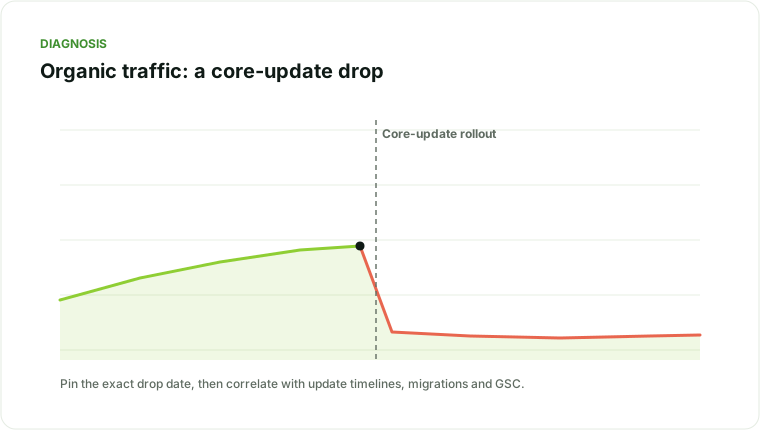
Was there a confirmed Google core update rolling out on or near that date? Google announces broad core updates publicly. If your drop date lines up within a few days of a confirmed rollout, and the drop hit a broad set of pages/queries rather than one cluster, this is your leading hypothesis. Core updates aren’t a switch you can flip back - recovery means addressing the quality signals Google is now weighing differently (content depth, author expertise, technical trust signals), not waiting it out.
Did anything change on your site around that date? Check your CMS changelog, deploy history, or ask your dev team what shipped. A redesign, a plugin update, a robots.txt edit, a sitemap regeneration, a CDN or hosting change - any of these can silently cause deindexation. This is the branch to check first because it’s usually the fastest to fix. Run a crawl (Screaming Frog or your own crawler) and diff it against a pre-drop crawl if you have one archived. Look specifically for: noindex tags that shouldn’t be there, a robots.txt disallow that’s too broad, canonical tags pointing to the wrong URL, or a spike in 4xx/5xx server responses.
Did the drop hit a specific topic cluster rather than the whole site? Pull the Performance report filtered to that cluster and check whether multiple URLs on your site rank for the same or overlapping queries. If two or three pages are trading positions in the SERP for the same term over time, that’s cannibalization - see the dedicated guide on how to find and fix keyword cannibalization for the full detection and consolidation method.
Is there a manual action listed? If yes, that overrides everything else - address it directly per Google’s stated reason before doing anything else.
If none of the above line up cleanly, widen the technical check. A full technical SEO audit checklist covers the areas a quick crawl can miss - Core Web Vitals regressions, structured data errors, and internal linking dilution - any of which can compound a smaller drop into a bigger one.
A diagnosis decision tree
Use this in order:
- Manual action in GSC? → Yes: address the specific violation, file reconsideration. Stop here.
- Drop coincides with a confirmed core update AND affects broad/mixed pages? → Yes: treat as a quality re-evaluation. Move to content-depth and E-E-A-T review, technical trust audit.
- Drop coincides with a site change (migration, redesign, CMS update)? → Yes: run a crawl diff. Check indexation status, redirects, canonicals, robots.txt. Fix and resubmit for indexing.
- Drop concentrated in one topic cluster with multiple competing URLs? → Yes: map query-to-page cannibalization, consolidate or differentiate.
- Impressions steady but clicks down? → Check SERP features and CTR by position; likely a snippet/feature loss, not a ranking loss.
- None of the above? → Check search demand trends for your core terms (Google Trends) and competitor movement. It may be a market shift, not an algorithmic one.
Most real-world drops are a combination - a core update surfaces which sites had underlying technical debt all along. That was exactly the Singapore case: the update didn’t invent a new problem, it amplified an existing one. The roadmap addressed both the content-quality gap and the technical issues in parallel, which is why the recovery held rather than bouncing.
Quick wins vs. when to get help
Some fixes you can make same-day:
- Remove an accidental noindex tag or overly broad robots.txt disallow
- Fix a canonical tag pointing to the wrong URL
- Resubmit an updated sitemap and request indexing on affected pages
- Merge or redirect two cannibalizing pages that are clearly duplicative
Others take longer and benefit from a second set of eyes - especially separating “the update changed what it rewards” from “we have a structural problem the update just exposed.” That distinction determines whether you’re publishing more content, fixing your technical foundation, or both.
A few signs it’s time to stop self-diagnosing and get a second opinion:
- The drop is broad (multiple clusters, not one page) and you can’t tie it to a single confirmed cause.
- You’ve made a fix and two to three weeks later, nothing has moved - meaning your working hypothesis was probably wrong.
- You’re about to commission a large volume of new content as a fix for what might actually be a technical or cannibalization problem - an expensive mistake if the diagnosis is off.
- Leadership is asking for a timeline and you don’t have enough confidence in the cause to give one.
If you’re staring at a drop and can’t confidently place it on the decision tree above, that’s the point to get a diagnosis rather than guess for another month while the gap widens. It’s also worth remembering that the fastest recoveries come from correctly separating causes that look identical on the surface - a core-update hit and a technical crawl issue can produce an almost identical GSC graph, but the fix for one does nothing for the other.
If your traffic has dropped and you want a second opinion on the cause before you spend a quarter chasing the wrong fix, I can help you recover organic traffic - starting with exactly this diagnosis, matched against real GSC data, not assumptions.
Traffic sliding, or planning a risky migration?
I diagnose why organic traffic dropped and reverse it - core updates, migrations, cannibalization, technical decay.
Explore SEO recovery services