Knowing how to avoid keyword cannibalization matters because it’s one of the quietest ways a site loses rankings - no penalty, no algorithm update, no red flag in Search Console. Just several pages competing for the same query until Google can’t decide which one deserves to rank, and picks none of them consistently. Traffic plateaus, or slowly declines, and it’s easy to misdiagnose as “we need more content” when the actual fix is the opposite: consolidate what you already have.
I’ve fixed this exact problem twice with strikingly similar before/after numbers. A Singapore family law firm had a divorce content cluster where 22 of 32 target keywords - representing roughly 8,800 monthly searches - were cannibalized across multiple pages. Rebuilding it into a proper pillar-cluster architecture with 301 redirects and deliberate internal linking took traffic from 40 to 713 visits a month at peak. Separately, a Southeast Asian hostel chain had homepage content competing directly against its own location pages for the same terms - a subtler version of the same problem - and fixing it broke an 18-month plateau, taking traffic from 93 to 924 visits a month. Neither engagement involved writing meaningfully more content. Both were architecture and consolidation.
What it is & why it stalls rankings
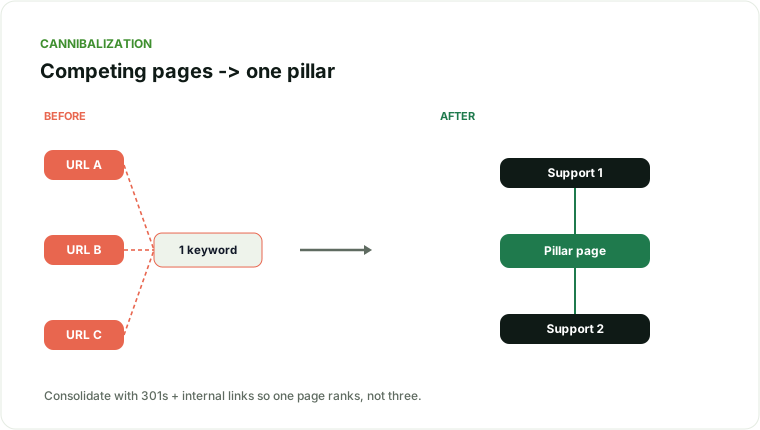
Keyword cannibalization happens when two or more pages on the same site target the same or very similar search query. Instead of one strong page competing against other domains, you have two or three of your own pages competing against each other - and against everyone else - simultaneously.
This matters because ranking signals (backlinks, internal links, engagement, topical relevance) get split across the competing pages instead of concentrated on one. Google also has to guess which page you actually want ranked, and it will guess inconsistently - you’ll often see the “wrong” page (older, thinner, less relevant) outranking the one you’d actually want a visitor to land on, or see rankings swap between two of your own URLs week to week in a rank tracker. That instability is often the first visible symptom, well before a traffic drop shows up.
Cannibalization typically comes from one of a few patterns:
- Organic growth without a content plan - years of blog posts published without checking what already exists, so a new post unintentionally overlaps an old one.
- Category/location page overlap - a homepage or top-level page ranking for the same term a dedicated location or category page is trying to own (the hostel chain’s exact issue).
- Near-duplicate intent variations - separate pages for singular/plural, “best X” vs. “top X,” or slightly different phrasings of the same underlying question.
- Migration or redesign debt - old pages left live after a redesign introduced new ones targeting the same topic, with no redirect or consolidation.
Detect it: GSC query-to-page mapping
The most reliable free keyword cannibalization checker is Search Console itself - no third-party tool required, though several exist if you want to automate this at scale.
The method:
- Go to Performance → Search Results.
- Add a filter for the specific query you suspect is cannibalized.
- Switch the “Pages” tab on and look at how many distinct URLs received impressions for that exact query over the selected period.
- If two or more pages show meaningful impressions for the same query, and especially if their positions are both mediocre (neither cracking the top 5) or swapping over time, you have cannibalization.
To do this at scale rather than query-by-query, export the full Performance data (queries + pages + clicks + impressions + position) via the API or bulk export, then pivot it in a spreadsheet: group by query, count distinct URLs, and flag any query with more than one URL earning a meaningful share of impressions. This is the same query-to-page mapping method I used to find the 22 cannibalized terms in the family law cluster - it surfaced the full scope in an afternoon rather than page-by-page guesswork.
A few other tells worth checking:
- Rank tracker instability - a keyword tracking tool showing your ranking URL for a term changing week to week is a strong cannibalization signal.
- Site: search - run
site:yourdomain.com "exact phrase"and see how many of your own pages return. - Internal link overlap - if your internal linking sends roughly equal link equity to two pages targeting the same term, you’ve architecturally built the conflict in.
Do you need a dedicated keyword cannibalization tool?
Several paid tools (Ahrefs, SEMrush, and dedicated cannibalization checkers) automate the query-to-page pivot described above and can flag conflicts across thousands of keywords at once - genuinely useful once a site has enough URLs that a manual spreadsheet pivot becomes unwieldy. For most small-to-mid sites, though, the free GSC method above catches the vast majority of real conflicts, because it’s grounded in what Google is actually doing with your pages right now rather than a third-party estimate of keyword-to-page mapping. I’d reach for a paid tool once a site crosses a few hundred indexed pages, and rely on the manual GSC pivot below that.
Consolidate vs. differentiate
Once you’ve confirmed cannibalization, you have exactly two valid fixes - and picking the wrong one wastes the effort.
Consolidate when the pages genuinely serve the same intent and there’s no good reason for both to exist. Merge the stronger content into the page you want to keep (usually the one with more backlinks, more historical traffic, or better structural fit), then 301 redirect the other to it. This was the fix for both case studies - the competing pages weren’t meaningfully different from a searcher’s perspective, so keeping both was pure dilution.
Differentiate when the pages should target genuinely different intents but currently don’t - for example, a “cost” page and a “process” page that both drifted into covering both topics. Here the fix is editorial: rewrite each page to clearly own its distinct angle, update titles/H1s/meta descriptions to reflect the split, and cross-link between them so users (and Google) understand they’re related but different.
The test I use: if you’d be comfortable deleting one of the two pages entirely and losing nothing a user needed, consolidate. If deleting either would leave a real content gap, differentiate.
301s + internal linking
Consolidation isn’t complete until the technical and architectural side is done:
- 301 redirect the losing URL to the winning URL - not a 302, and not just a “noindex and hope.” A 301 passes link equity and tells Google definitively which page replaces the other.
- Update all internal links that pointed to the old URL to point directly to the new one. Relying on the redirect alone leaves a chain that dilutes equity and slows crawl discovery of the correct page.
- Rebuild the internal linking around the surviving page as a pillar. Related content should link into it with descriptive, varied anchor text - this is the architecture fix that prevents the next cannibalization conflict from forming, and it’s the same pillar-cluster principle covered in the technical SEO audit checklist.
- Update or resubmit the XML sitemap so it reflects only the surviving URL.
- Monitor GSC for 3-4 weeks post-fix - rankings for consolidated queries usually stabilize onto the single surviving URL within that window, sometimes faster.
Before/after: two real cases
Family law firm, Singapore. The divorce content cluster had grown organically over several years into 32 target keywords, 22 of which were split across competing pages - representing about 8,800 monthly searches worth of cannibalized volume. The fix was a full pillar-cluster rebuild: one pillar page for the core topic, differentiated cluster pages for genuinely distinct sub-questions, 301s consolidating the true duplicates, and internal linking rebuilt around the new structure. Traffic went from 40 to 713 visits a month at peak.
Hostel chain, Southeast Asia. The conflict here was subtler - homepage content competing against location-specific pages for the same booking-intent terms, which is a common pattern for any multi-location business. Traffic had been flat for 18 months before the fix. Differentiating the homepage’s role (brand and navigation) from the location pages’ role (transactional, location-specific intent) and rebuilding internal links accordingly took traffic from 93 to 924 visits a month - breaking the plateau without adding a single new page.
Both cases follow the same underlying diagnosis, which is worth internalizing: a traffic plateau or an unexplained ranking instability is often not a “we need more content” problem. It’s frequently a “our own pages are fighting each other” problem, and the fix is subtractive - merge, redirect, and rebuild the linking - before it’s additive.
Prevent it going forward: how to avoid keyword cannibalization long-term
Once fixed, prevent recurrence with a few habits baked into your content process rather than a one-off cleanup:
- Search your own site before publishing anything new. A quick
site:yourdomain.com keywordcheck, or a scan of your content calendar/keyword tracker, takes five minutes and is far cheaper than an audit eighteen months later. - Keep a single keyword-to-URL map. One spreadsheet mapping primary target keyword to the one page that owns it, updated every time you publish. When a new topic idea comes up, check the map first.
- Assign clear ownership per topic cluster. Cannibalization creeps in fastest when multiple writers or contractors work on overlapping topics without visibility into what already exists.
- Re-run the GSC query-to-page pivot quarterly on your top 50-100 keywords, even if nothing feels wrong. Cannibalization is gradual - by the time it shows up as a traffic drop, it’s usually been building for months.
If your traffic has plateaued and you suspect your own pages might be competing with each other, that’s worth diagnosing before assuming you simply need more content - see the organic traffic drop diagnosis framework for the broader decision tree cannibalization sits inside.
If you want a second set of eyes on whether cannibalization - or something else entirely - is behind a stalled cluster, my SEO recovery services start with exactly this kind of query-to-page mapping before recommending any fix.
Traffic sliding, or planning a risky migration?
I diagnose why organic traffic dropped and reverse it - core updates, migrations, cannibalization, technical decay.
Explore SEO recovery services