Google core update recovery starts with a diagnosis most site owners skip: confirming whether what happened is actually a quality re-evaluation rather than a penalty, because the two require completely different responses, and treating one like the other wastes months. A core update isn’t a switch that gets flipped back - there’s no “undo” and no reconsideration request, because nothing was violated. What happened is that Google re-assessed what “the best answer” looks like for your topic, and your pages scored differently against that new bar. Recovery means closing the specific gap the update revealed, not waiting it out.
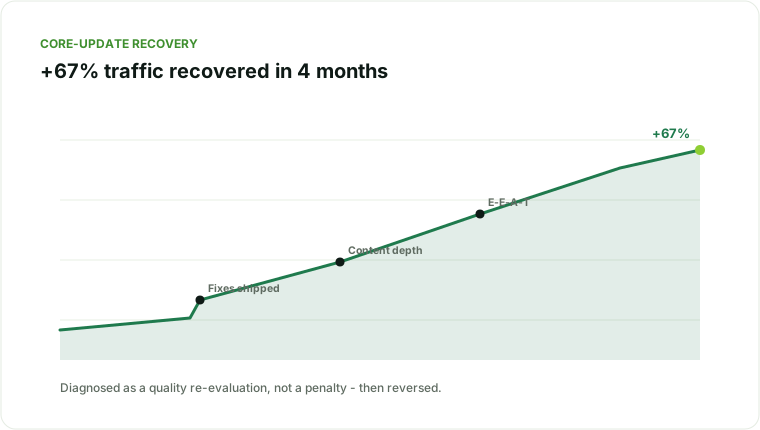
I diagnosed and recovered exactly this scenario for a Singapore corporate services SME. A core update dropped roughly 70% of its tracked keywords, with 8 falling completely out of the top 100 - a collapse severe enough that the instinctive read was “we’ve been penalized.” The actual diagnosis, built from GSC and rank-tracker analysis, was a quality re-evaluation amplified by underlying technical issues - not a manual action, not a penalty. The recovery roadmap that followed brought back +67% of traffic within four months. Here’s the framework, step by step.
Step 1: Confirm it’s actually a core update, not something else
Before building a recovery plan around “the algorithm changed,” rule out the alternatives - because the fix for each is different and a core-update response won’t touch a technical or manual-action problem.
- Check Security & Manual Actions in GSC. If there’s a manual action listed, that’s a separate, narrower process (address the specific violation Google names, then file reconsideration) - not what this guide covers.
- Check the drop date against confirmed core update rollout dates. Google publicly announces broad core updates. If your drop lines up within a few days of a confirmed rollout and hit a broad, mixed set of pages rather than one isolated section, a core update is the leading hypothesis.
- Rule out a technical or migration cause. Check whether anything changed on your site around the same date - a redesign, a plugin update, a robots.txt change. If a core update coincides with an unrelated technical change, you may be dealing with both at once, which is exactly what happened in the case above.
The fuller version of this triage - including cannibalization and other causes - is covered in the organic traffic drop diagnosis framework, which is worth running in full before assuming core update is the sole cause.
What “amplified by technical issues” actually looked like
Naming the specific technical findings from the SME case is more useful than describing them abstractly. The technical review turned up a mix of moderate crawl-budget waste from an unbounded faceted navigation, several key pages with duplicate or thin meta content inherited from a templated CMS, and inconsistent internal linking that left some of the site’s strongest commercial pages under-linked relative to lower-value ones. None of these alone would explain a 70% keyword collapse. Together, they meant the site’s technical baseline was already weak going into the update - so when Google’s quality bar moved, there was very little buffer, and pages that might have held on a technically cleaner site fell hard instead.
Step 2: Understand what core updates actually reward
Google’s guidance on core updates centers on content quality, expertise, and trustworthiness - commonly shortened to E-E-A-T (experience, expertise, authoritativeness, trust). Concretely, that translates into questions worth auditing your top-affected pages against:
- Does the content demonstrate first-hand experience or expertise, or does it read like a generic summary of what’s already ranking?
- Is authorship clear, and does the author (or business) have a credible claim to expertise on this topic?
- Does the page fully answer the query, or does it require the reader to go elsewhere to get a complete answer?
- Are there trust signals - accurate information, transparent sourcing, a real business behind the content - or does it read as thin, templated, or auto-generated?
- Does the site’s technical foundation support the content, or is a good page held back by poor crawlability, weak internal linking, or slow load times?
That last point is the one most core-update post-mortems miss. Google doesn’t publish “technical issues amplified this update’s impact on you” as feedback, but in practice, a core update tends to hit hardest where content-quality gaps and technical weaknesses compound each other. A borderline page might have survived on a technically strong site and gotten fully buried on one with crawl and indexation issues dragging down the whole domain’s perceived quality.
Step 3: Diagnose your specific gap (don’t guess from generic advice)
Generic “improve E-E-A-T” advice is true and mostly useless without site-specific diagnosis. The actual diagnostic process:
- Identify exactly which keywords and pages dropped, using GSC Performance data filtered to the update date. Segment by whether the affected pages share a topic, a template, or an author - patterns here point directly at the gap.
- Compare your affected pages against what’s now ranking in their place. What does the new top-ranking content do that yours doesn’t? This is uncomfortable but essential - the answer is rarely “nothing, it’s random,” even though it can feel that way.
- Run a technical audit in parallel, not as an afterthought. In the SME case, the technical review surfaced issues that were plausibly compounding the content-quality signal - the kind of finding a content-only response would have missed entirely. See the technical SEO audit checklist for what this review should cover.
- Rank the gaps you find by how many affected keywords/pages they touch. A single structural issue (e.g., thin author bios site-wide, or a technical crawl problem affecting a whole content type) is worth fixing before individual page-level content tweaks, because it compounds across every affected page at once.
Step 4: Build and execute the recovery roadmap
The roadmap that worked in the SME case had three parallel tracks, not a single linear fix list:
- Content depth and E-E-A-T fixes on the highest-impact affected pages - closing the specific gap identified in step 3, not a blanket rewrite of everything.
- Technical fixes addressing the issues found in the parallel audit - these tend to lift the whole domain’s baseline rather than any single page.
- Ongoing monitoring against the rank tracker and GSC, checking whether the specific keywords that dropped are recovering as fixes ship, so the roadmap can be adjusted based on what’s actually working rather than executed blindly to completion.
Sequencing the roadmap
Order matters more than most recovery plans acknowledge. The sequence that worked in the SME engagement:
- Technical fixes first, because they’re typically faster to implement and remove a ceiling that would otherwise cap the benefit of every content improvement that follows.
- Highest-impact content gaps second - the pages responsible for the largest share of the 70% keyword loss, not every affected page at once. Fixing the pages with the most search volume behind them first gets visible movement into the rank tracker faster, which matters for keeping stakeholders confident the plan is working.
- Remaining content and structural cleanup third - lower-impact pages, broader E-E-A-T signals (author pages, trust pages, about/credentials content) that support the whole domain rather than any single keyword.
Running all three simultaneously is possible with enough resourcing, but sequencing this way makes it possible to check early signal (did the technical fixes move anything within 4-6 weeks?) before committing further budget to the content phase.
How long core update recovery actually takes
Set expectations honestly: core update recovery is not a same-week fix, even when diagnosed correctly. In the SME case, the +67% recovery took four months from roadmap implementation, not from the original drop date - first from stabilizing the technical foundation, then from Google reassessing the content changes on subsequent crawls and, in some cases, subsequent core update cycles. Google has been explicit that meaningful shifts from a page’s content improvements sometimes aren’t fully reflected until a later update cycle, which is part of why “wait and see” without action is the wrong strategy, but “expect overnight results” is equally wrong.
A realistic timeline: technical fixes can show partial signal within 4-6 weeks; content and E-E-A-T improvements typically need 2-4 months to fully compound, sometimes bridging into the next core update cycle before the full recovery shows.
Frequently asked
Is there a way to speed up google update recovery time? Not by asking Google to reconsider - there’s no reconsideration process for algorithmic ranking shifts, only for manual actions. The only lever that shortens the timeline is fixing the underlying gaps faster and more precisely, which is why an accurate diagnosis matters more than raw effort. Throwing generic “E-E-A-T improvements” at every page uniformly is slower than fixing the specific pages and specific gaps the update actually penalized.
Can a core update ranking drop be permanent? For most sites, no - but “eventually” isn’t a plan. Recovery requires action; a core-update-affected site that changes nothing has no structural reason to recover just because time passes, since the quality bar that changed hasn’t moved back. Sites that do nothing sometimes see partial recovery on a later update as competitors’ content also evolves, but this is a slow, unreliable path compared to a direct fix.
Do I need to wait for the next core update to see recovery? Not necessarily. Google has stated that ranking improvements from content and technical changes can sometimes be reflected before the next named core update, through normal recrawling and reassessment - but larger, more holistic quality reassessments are more reliably reflected at the next core update cycle. This is part of why the 4-month timeline in the case above spanned normal reassessment rather than a single event.
What not to do
- Don’t do a wholesale content purge or rewrite everything at once. Without a specific diagnosis, this risks removing things that were actually fine and burns the time better spent on the gap that’s actually causing the drop.
- Don’t treat it as a penalty and look for a violation to fix. If there’s no manual action listed in GSC, there’s no violation - chasing one wastes the window better spent on content and technical improvement.
- Don’t ignore the technical layer because “it’s a core update, not a technical problem.” As the SME case shows, the two frequently compound, and a technical fix can be the faster half of the recovery.
If you’re staring at a core-update-shaped drop and want help separating what’s a genuine content gap from what’s a technical amplifier, that’s exactly the diagnosis I run to recover organic traffic after a core update - matched against your specific GSC data and rank history, not generic advice.
Traffic sliding, or planning a risky migration?
I diagnose why organic traffic dropped and reverse it - core updates, migrations, cannibalization, technical decay.
Explore SEO recovery services