How long does SEO for a site migration take to recover? For a well-planned migration, the honest answer is that you shouldn’t be measuring “recovery” at all - you should see a brief adjustment period of one to four weeks while Google re-crawls and re-indexes the new URLs, not a genuine loss to bounce back from. For a poorly planned migration, recovery can take anywhere from two to six months, and in the worst cases - where redirects were never properly mapped - some of the lost rankings never fully return, because the specific relevance signals tied to the old URLs are gone for good.
The gap between those two outcomes isn’t luck. It’s almost entirely determined by what happened before launch, not after.
Why the answer is “it depends on the migration, not the recovery”
Framing this as a recovery-time question is slightly backwards. The migrations that “recover” fastest are the ones that were never actually damaged - they were protected pre-launch with a baseline crawl, a complete redirect map, and staging QA, so what looks like recovery afterward is really just Google catching up to a change that didn’t break anything.
I ran a full site migration for a Singapore moving company with this approach and held 5,000-8,000 visits a month throughout the entire migration, with zero organic traffic loss. There was no recovery period to measure, because there was no drop. That’s the outcome the checklist in my SEO migration checklist is built to produce - the pre/post crawl-comparison method catches redirect and indexation problems before launch, which is structurally faster than any post-launch fix.
How long SEO migration recovery takes, by scenario
Well-executed migration, full redirect map, staging QA completed: Expect a brief dip or plateau of 1-2 weeks while Google recrawls the new URLs, sometimes not even visible in aggregate traffic. Rankings should be fully restored to pre-migration levels within 2-4 weeks. This is the outcome the pre/post crawl-comparison method targets - a monitored non-event rather than a drop-and-recovery curve.
Partial redirect mapping, most URLs covered but some gaps: Expect a real dip of 20-40% in the affected segments, typically visible within days of launch. Recovery once the gaps are found and fixed usually takes 4-8 weeks, since Google needs to recrawl and re-index the corrected redirects, and rankings rebuild incrementally rather than snapping back immediately.
No redirect map, or a wildcard “redirect everything to homepage” approach: This is the scenario that produces genuine, prolonged damage. Expect losses of 50-90% of migration-affected traffic, and recovery - once proper redirects are retroactively implemented - can take 3-6 months, because you’re not just fixing a technical error, you’re rebuilding relevance signals that were severed rather than preserved. Some long-tail rankings tied to very specific old URLs may never fully return.
Domain change specifically (not just URL restructure): Even with a strong redirect map, domain changes carry a longer natural adjustment period than same-domain migrations, because Google is re-establishing trust signals for the new domain in addition to processing the URL mapping. Expect 4-8 weeks minimum even in a well-executed domain migration, versus 1-4 weeks for a same-domain URL restructure.
What determines your actual number
Three factors matter more than anything else:
- Redirect map completeness. This is the single biggest lever. A 100% mapped migration and a 70% mapped migration are not “30% worse” - the gap in outcome is nonlinear, because unmapped high-authority URLs disproportionately drive the loss.
- How fast problems are caught. A gap found and fixed on day one costs days of recovery. The same gap found six weeks later, after Google has already recrawled and demoted the broken URLs, costs months - because you’re now waiting for a second recrawl cycle to reflect the fix.
- Whether content changed at the same time as the URL structure. Migrations bundled with a content refresh or redesign are harder to diagnose and slower to recover, because a drop could be from the migration, the content changes, or both - untangling that costs time the migration alone wouldn’t have.
How to tell “normal adjustment” from “real loss” while it’s happening
Two signals separate a healthy re-indexing window from an actual problem:
- Impressions vs. clicks. In a normal adjustment period, impressions for your key terms often hold roughly steady (Google still knows the content exists) while clicks and average position wobble for a couple of weeks as ranking signals transfer to the new URLs. If impressions themselves are collapsing, that’s a stronger signal of a real indexation problem - pages not being found or crawled at all, not just re-ranking.
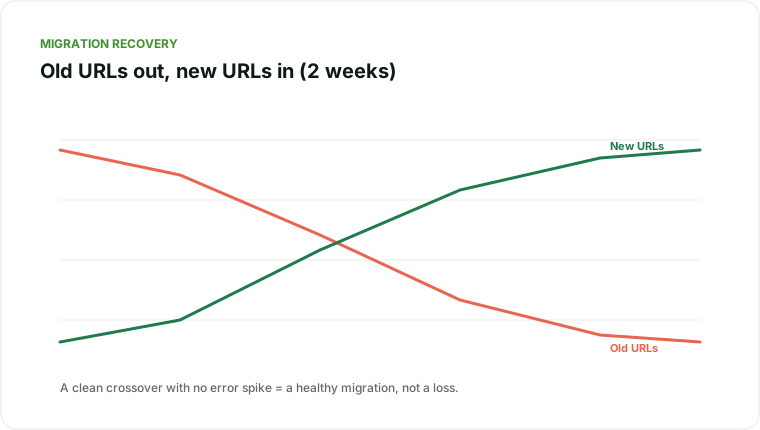
- Index coverage trend. Check Search Console’s Index Coverage report daily for the first two weeks. A steadily rising “indexed” count for the new URL structure, mirrored by old URLs dropping out cleanly (not erroring), is the fingerprint of a healthy migration in progress. A flat or declining indexed count, or old URLs stuck in “Discovered - currently not indexed,” signals the redirect map isn’t being picked up correctly.
Neither of these requires waiting a month to know something is wrong - both are visible within the first several days if you’re checking daily, which is exactly the cadence the crawl-comparison method is built around.
If you’re mid-migration and already seeing a drop
Confirm first whether this is the normal 1-2 week adjustment window or a genuine loss: check whether impressions are recovering even if clicks haven’t yet, and check the redirect map for gaps using the crawl-comparison method described in the migration checklist. If it’s a genuine loss rather than a normal adjustment, the fix is the same either way - find and correct the redirect gaps as fast as possible, since time-to-fix is the biggest lever on your actual recovery timeline from this point forward.
If a migration already happened without this process and you’re not sure whether what you’re seeing is normal or a real problem, that’s worth a proper diagnosis rather than waiting to see what happens - my SEO migration help engagements start by running exactly this crawl-comparison check against your specific redirect map and timeline.
Traffic sliding, or planning a risky migration?
I diagnose why organic traffic dropped and reverse it - core updates, migrations, cannibalization, technical decay.
Explore SEO recovery services